NTAG213 vs NTAG215 vs NTAG216: Which NFC Chip Should You Use?
November 02, 2026
We have deployed these RFID tags for tracking pallets and cartons in our cross-border logistics operations. The read rate has remained stable even with mixed loading and high-speed conveyor belts. Compared to our previous tags, the false scan rate has been significantly reduced, and it has become much easier for the warehouse team to handle exceptions.
Daniel – Logistics Operations Lead @ International Freight Company
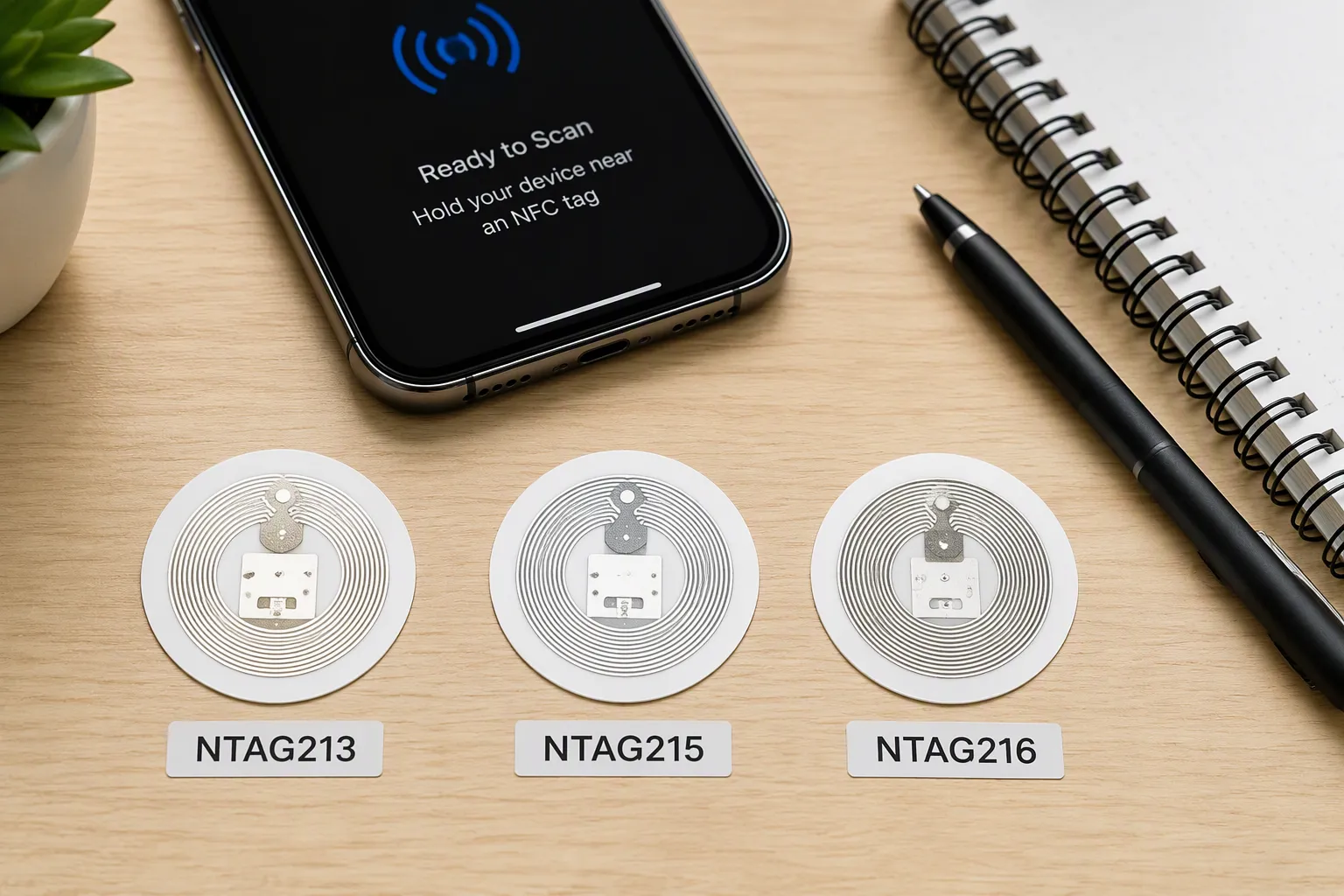
The ntag213 vs ntag215 vs ntag216 decision comes down to two questions: how much data you need to store, and what you can spend per tag. NTAG213 suits simple, cost-sensitive tags. NTAG215 delivers balanced, mid-range memory. NTAG216 handles data-rich applications. All three share the same NTAG21x core features and standards compliance, so memory size and cost per tag are your deciding factors.
Key Takeaways
Choose NTAG213 for simple, high-volume tags like product labels and posters. It offers 144 bytes of memory at the lowest cost per tag.
Pick NTAG215 for balanced projects like event check-in or gaming tags. It provides 504 bytes of memory at a mid-range price.
Use NTAG216 for data-rich applications like long URLs or asset logs. It delivers 888 bytes of memory for maximum storage needs.
NTAG213 vs NTAG215 vs NTAG216: The Short Answer
You can settle the ntag213 vs ntag215 vs ntag216 question quickly once you frame it around payload size and unit cost. Each chip in the NTAG21x family uses the same underlying technology and the same standards. The difference sits almost entirely in how many bytes of user memory the chip carries and what that capacity costs you per tag.
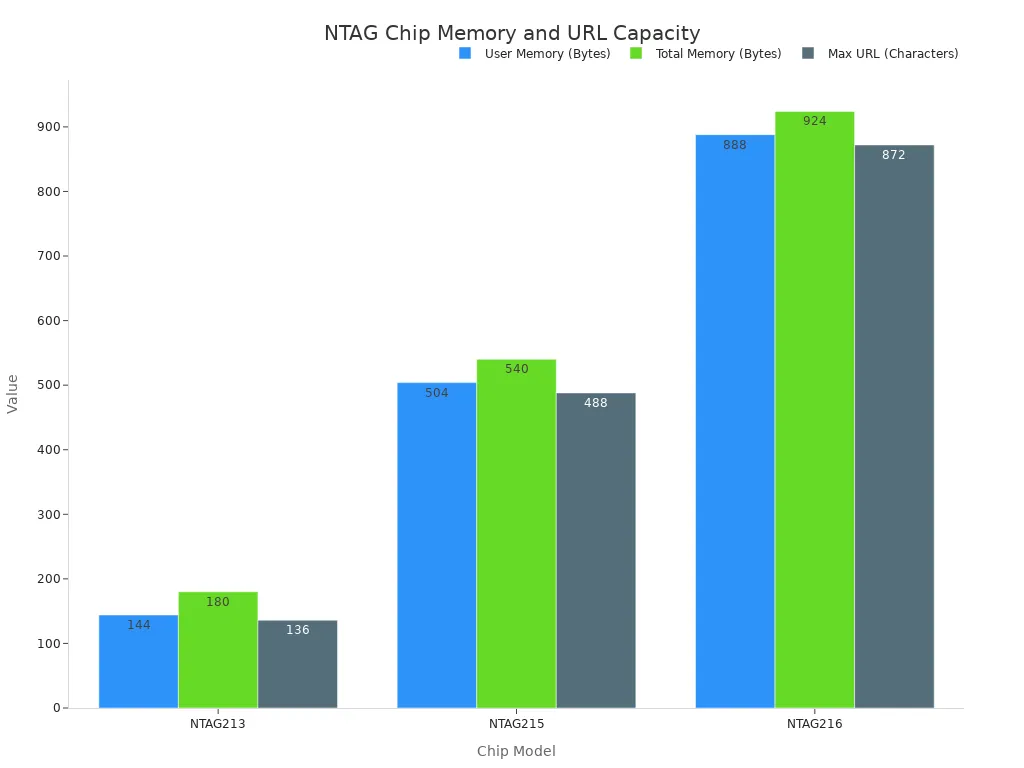
The table below gives you the core numbers at a glance.
Chip
User Memory
Total Memory
Max URL
NTAG213
144 Bytes
180 Bytes
136 Characters
NTAG215
504 Bytes
540 Bytes
488 Characters
NTAG216
888 Bytes
924 Bytes
872 Characters
NTAG213 for Simple, High-Volume Tags
The NTAG213 gives you 144 bytes of user memory, which translates to a maximum URL length of about 136 characters. That ceiling covers a plain website link, a short message, or a product page address. It does not leave room for long tracking parameters or multi-field records.
This chip shines when you deploy tags by the thousand. Smart packaging, posters, postcards, product labels, and authentication labels all fit the NTAG213 profile. The chip supports unique UID-based identification, so you can build anti-counterfeiting and traceability programs on top of it. Industrial teams also use it for asset identification and internal process automation.
Cost is the headline here. The NTAG213 runs roughly $0.10 cheaper per tag than the NTAG215, and high-volume inlay pricing can fall to about $0.14 per unit. You pay for exactly the memory you need and nothing more. For a campaign that only needs a landing page link, that discipline adds up across a large order.
NTAG215 for Balanced, Mid-Range Projects
The NTAG215 steps up to 504 bytes of user memory and a 488-character URL ceiling. That jump is more than three times the NTAG213 capacity, and it opens the door to richer interactions. You can store a full vCard, a long tracking URL, or a structured record for a game character.
Gaming and collectibles communities know this chip well. The NTAG215 became the tag of choice for Amiibo figures, and it remains the standard for fixed-memory gaming applications. Event check-in systems, access credentials, digital identities, and device-triggered content also fit comfortably within its capacity.
The pricing story stays friendly. Bulk NTAG215 tags typically land in the $0.20 to $0.35 range, and retail tags run about $0.50 to $1.00. Compared with the NTAG216, you save roughly $0.10 to $0.15 per tag at the 1,000-piece mark. That gap funds a lot of extra tags when your payload fits in 504 bytes.
NTAG216 for Maximum Storage Capacity
The NTAG216 carries 888 bytes of user memory and supports URLs up to 872 characters. It holds the largest payload in the NTAG21x series. You reach for this chip when your data simply will not compress into a smaller footprint.
Think about long URLs loaded with UTM tracking parameters, rich vCards with multiple phone numbers and social links, or offline configuration files for devices and sensors. Multi-record NFC cards, product manuals stored on tag, and industrial asset tags with maintenance logs all need this headroom. Advanced marketing campaigns that store promo text, coupon codes, or A/B testing payloads also benefit from the extra space.
The premium is real but manageable. Bulk NTAG216 tags run about $0.35 to $0.50, and retail tags sit near $0.80 to $1.50. You pay more per tag, so reserve this chip for applications where the data genuinely demands it. A simple URL tag wastes money on an NTAG216. A data-rich vCard program wastes user experience on an NTAG213.
The NTAG21x Family at a Glance
One Family, Three Memory Sizes
All three chips belong to the same NTAG21x family, so they share a common technical foundation. You get the same NFC Forum Type 2 compliance, the same 100,000 write cycle endurance, and the same 10-year data retention across every variant. The table below shows the specifications that stay constant.
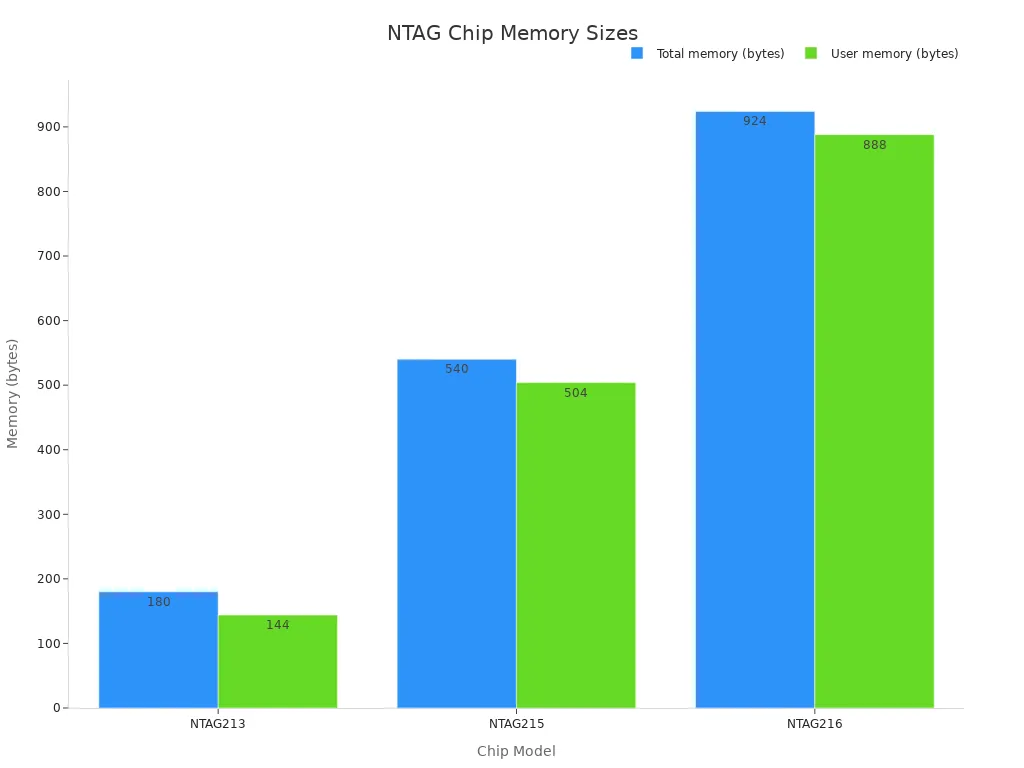
Memory is the one specification that changes. The NTAG213 has 144 bytes of memory, whereas the NTAG215 has 504 bytes. The memory size of the NTAG216 is 888 bytes.
Why Memory Is the Main Differentiator
Memory size drives nearly every practical difference between these chips. You can segment NTAG21x memory to run multiple applications at once. High input capacitance also lets the chips fit small-footprint designs without sacrificing performance, so you can embed them in product labels or electronic devices.
A larger memory block costs more to produce, and that cost passes to your per-tag price. The chip you choose therefore sets both your data ceiling and your unit budget. Match the memory to your payload, and you avoid paying for capacity you never use.
Quick Comparison Table
Memory, Scan Endurance, Use Cases, and Cost Side by Side
The ntag213 vs ntag215 vs ntag216 comparison becomes clearer when you line up the four factors that matter most: memory, scan endurance, typical use cases, and cost per tag. The table below puts them side by side.
Factor
NTAG213
NTAG215
NTAG216
User memory
144 bytes
504 bytes
888 bytes
Max URL length
136 characters
488 characters
872 characters
Write cycles
100,000
100,000
100,000
Data retention
10 years
10 years
10 years
Typical use cases
Product labels, posters, authentication
Gaming tags, event check-in, vCards
Long tracking URLs, asset logs, multi-record cards
Bulk cost per tag
~$0.14
~$0.20–$0.35
~$0.35–$0.50
Scan endurance stays identical across the family, so it never tips the decision. The NTAG213 stores its 144 bytes of user memory across 36 pages of 4 bytes each, which suits short links and simple records. The NTAG215 and NTAG216 scale that same page structure up to larger payloads.
NTAG213, NTAG215, and NTAG216 are rated for 100,000 write cycles and 10 years of data retention measured from the last write. Reading a tag doesn't draw down either number. Only writing and erasing do.
That endurance profile means your choice hinges on capacity and budget, not durability. Pick the smallest chip that holds your payload, and you keep cost per tag low without sacrificing reliability.
NTAG213: The Cost-Efficient Choice
How Much Memory Does the NTAG213 Offer?
The NTAG213 gives you 144 bytes of user memory, organized across 36 pages of 4 bytes each. That capacity supports a URL of up to 136 characters. You can store a short web link, a product page address, or a simple text record. The chip also carries a factory-locked unique ID, so you can build identification and traceability programs on top of it. If your payload fits inside 144 bytes, you never pay for memory you cannot use.
You get the most value from this chip in high-volume deployments. Smart packaging, posters, postcards, and product labels all suit the NTAG213 profile. Authentication labels and asset identification tags work well too. Marketing teams use it for campaign links, and operations teams use it for internal process automation. Each tag carries one clear job, and the memory covers that job without waste.
Why NTAG213 Is the Budget Pick
Cost per tag drives the ntag213 vs ntag215 vs ntag216 decision for large orders. The NTAG213 runs roughly $0.10 cheaper per tag than the NTAG215, and high-volume inlay pricing can reach about $0.14 per unit. That gap compounds fast across thousands of tags. You keep full NTAG21x reliability, including 100,000 write cycles and 10-year data retention, at the lowest unit price in the family.
NTAG215: The Balanced Middle Option
How Much Memory Does the NTAG215 Offer?
The NTAG215 delivers 504 bytes of user memory, organized across 126 pages of 4 bytes each. That capacity supports a URL of up to 488 characters. You get more than three times the storage of the NTAG213, and that headroom changes what you can build. A full vCard, a long tracking link, or a structured data record all fit comfortably. The chip keeps the same factory-locked unique ID and the same page structure as its smaller sibling, so your existing workflows carry over without rework.
Best Uses for NTAG215 Tags
This chip fits projects that need more than a simple link but stop short of data-heavy storage. Gaming and collectibles applications rely on it, including Amiibo-style figures with fixed memory needs. Event check-in systems, access credentials, digital identities, and device-triggered content all sit within its range. Marketing teams use it for campaign links with tracking parameters. The 504-byte ceiling covers most interactive experiences without waste.
Where NTAG215 Fits on Cost
Cost positioning separates the three chips cleanly. The NTAG213 serves as the most cost-effective option, the NTAG215 occupies the medium tier, and the NTAG216 sits at the high end.
Chip
Cost Positioning
NTAG213
Most cost-effective
NTAG215
Medium
NTAG216
High-end
The NTAG215 acts as a multi-functional balancer. You pay a modest premium over the NTAG213 and gain extra memory for more complex data. Bulk pricing typically lands between $0.20 and $0.35 per tag. That middle position makes the ntag213 vs ntag215 vs ntag216 trade-off easy to settle when your payload outgrows 144 bytes but never approaches 888.
NTAG216: The High-Capacity Option
How Much Memory Does the NTAG216 Offer?
The NTAG216 provides 888 bytes of user memory, organized across 222 pages of 4 bytes each. That capacity supports a URL of up to 872 characters. You get more than six times the storage of the NTAG213 and roughly 75% more than the NTAG215. The chip keeps the same factory-locked unique ID and the same page structure as the rest of the family. It also carries the same 100,000 write cycle endurance and 10-year data retention. Standard NFC phones read and write it without special hardware, because it belongs to the NFC Forum Type 2 family alongside its smaller siblings.
Best Uses for NTAG216 Tags
You reach for this chip when your payload will not compress into a smaller footprint. Long URLs loaded with UTM tracking parameters, rich vCards with multiple phone numbers and social links, and offline configuration files for devices and sensors all need this headroom. Multi-record NFC cards, product manuals stored on tag, and industrial asset tags with maintenance logs also fit. Advanced marketing campaigns that store promo text, coupon codes, or A/B testing payloads benefit from the extra space.
When the Extra Capacity Is Worth It
NTAG216 delivers the highest memory capacity and advanced encryption, meeting requirement profiles that smaller chips cannot serve.
The premium is real but manageable. Bulk NTAG216 tags run about $0.35 to $0.50, and retail tags sit near $0.80 to $1.50. Reserve this chip for applications where the data genuinely demands it. A simple URL tag wastes money on an NTAG216. A data-rich vCard program wastes user experience on an NTAG213. Weigh the ntag213 vs ntag215 vs ntag216 trade-off against your actual payload, and the answer becomes clear.
Shared Technical Specifications
Common Features Across All Three Chips
Every chip in the NTAG21x family shares the same core engineering. You get identical reliability and behavior regardless of which memory size you pick. The table below lists the specifications that stay constant.
Feature
Shared specification
NFC Forum tag type
Type 2
Operating frequency
13.56 MHz
Write endurance
100,000 write cycles
Data retention
10 years
Unique identifier
Factory-locked 7-byte UID
Memory structure
4-byte pages
Input capacitance
High capacitance for small designs
The chips also support password protection and a one-way counter. You can lock memory pages to prevent overwriting. These features let you build secure authentication and traceability programs on any of the three variants.
Compatibility and Standards
All three chips comply with ISO/IEC 14443-A and the NFC Forum Type 2 specification. Any NFC-enabled smartphone reads and writes them without special hardware or apps. You can encode tags with standard NDEF records, so your content works across Android and iOS devices.
The shared page structure means your encoding workflow carries over between chips. A tool or process built for the NTAG213 works the same way on the NTAG215 and NTAG216. This consistency simplifies production and reduces errors when you run multiple tag types in one program.
How to Choose the Right Chip
You now have the full picture of each chip's capacity, cost, and shared features. The next step turns that knowledge into a decision. A structured approach keeps you from overbuying memory or underbuilding your payload. Work through the questions below in order, and the right chip will surface on its own.
Key Questions to Ask Before You Decide
Start with your payload. Measure the exact byte count of the data you plan to write to each tag. A plain URL, a vCard, a JSON record, and a configuration file all carry different footprints. Add a safety margin of 20 to 30 percent for future edits, encoding overhead, and NDEF record structure. That margin protects you from a tag that fits today but fails after a small content update.
Next, estimate your order volume. Volume magnifies every cent of unit cost. A $0.10 gap per tag becomes $1,000 across 10,000 tags. High-volume programs reward the smallest chip that holds your payload. Low-volume or premium programs give you more room to absorb a higher unit price.
Then map your read and write patterns. Ask how often each tag gets rewritten. All three chips share the same 100,000 write cycle endurance, so this factor rarely changes the chip choice. It does shape how you design your encoding workflow and how often you refresh tag content in the field.
Consider your deployment environment. Tags on metal, tags inside packaging, and tags on curved surfaces all need the right inlay and antenna design. The chip itself stays the same across form factors. Confirm your supplier can pair the chip you choose with an inlay that survives your physical environment.
Finally, define your security needs. All three chips support password protection, memory locking, and a one-way counter. If your application needs authentication or tamper evidence, build that requirement into your chip and inlay specification from the start. Retrofitting security onto a live program costs far more than planning for it upfront.
Matching Memory to Your Application
The fastest path to the right chip runs through your application type. The table below maps common use cases to the chip that fits them best.
Application type
Recommended chip
Why it fits
Product labels, posters, postcards
NTAG213
Short URL fits in 144 bytes at the lowest unit cost
Authentication and traceability labels
NTAG213
UID-based identification needs minimal memory
Campaign links with tracking parameters
NTAG215
488-character URL ceiling covers most tracking strings
Event check-in and access credentials
NTAG215
Structured records fit in 504 bytes
Gaming and collectibles tags
NTAG215
Fixed-memory game data fits the 504-byte block
Rich vCards with multiple fields
NTAG216
Multiple phone numbers and links need the larger block
Long URLs with heavy UTM strings
NTAG216
872-character ceiling absorbs long tracking payloads
Asset tags with maintenance logs
NTAG216
Multi-record history needs 888 bytes
Offline device configuration files
NTAG216
Configuration data exceeds smaller memory blocks
Read your row in that table and check it against your measured payload. If your data fits the NTAG213 ceiling with margin to spare, choose the NTAG213 and bank the savings. If your payload clears 144 bytes but stays under 504, the NTAG215 gives you headroom without premium pricing. Reserve the NTAG216 for payloads that genuinely exceed 504 bytes.
Run one more test before you commit. Encode a sample tag with your real content and scan it with the phones your users actually carry. This step catches encoding errors, URL length surprises, and app compatibility issues early. A small pilot order of each candidate chip removes guesswork from the final decision.
The ntag213 vs ntag215 vs ntag216 choice rewards discipline. Match the chip to your measured payload and your volume, and you get reliable NFC performance at the lowest cost your application allows. Meihe supplies all three memory sizes, so you can order the exact chip your project needs without compromise.
You need a supplier who delivers the same reliability across every memory size. Meihe supplies the full NTAG21x family, so you can source NTAG213, NTAG215, and NTAG216 chips from one trusted partner.
Consistent Quality Across All Three Memory Sizes
Meihe applies the same quality standards to every chip in the NTAG21x line. Each unit meets NFC Forum Type 2 compliance and ISO/IEC 14443-A requirements. You get 100,000 write cycle endurance and 10-year data retention on every order, whether you buy 144-byte NTAG213 tags or 888-byte NTAG216 tags. Batch-to-batch consistency protects your encoding workflow and keeps your production line running without surprises. Meihe tests each lot before shipment, so the chips you receive match the specifications you designed around.
Support for Matching the Right Chip to Your Project
Choosing the right chip takes more than a spec sheet. Meihe helps you match memory size to your actual payload and volume. Share your application details, and the team will recommend the chip that fits your data ceiling and your budget. You can request sample tags of each variant to test encoding and scanning with your real content. Meihe also supports inlay and antenna selection, so your chosen chip performs in your physical environment. This guidance removes guesswork from the ntag213 vs ntag215 vs ntag216 decision and helps you order with confidence.
The ntag213 vs ntag215 vs ntag216 decision rests on two factors: your data volume and your cost per tag. Choose the NTAG213 for simple, high-volume tags, the NTAG215 for balanced mid-range needs, and the NTAG216 for data-rich applications. Match the chip to your requirements instead of defaulting to the largest option. Meihe supplies all three, so you can order the right fit with confidence.
FAQ
Can you read NTAG213, NTAG215, and NTAG216 tags with any smartphone?
Yes. All three chips meet the NFC Forum Type 2 standard. Any NFC-enabled Android or iOS phone reads and writes them without special apps or hardware.
Is NTAG216 overkill for a simple marketing link?
Often, yes. A short URL fits the NTAG213's 136-character ceiling. Choose the NTAG216 only when your payload genuinely exceeds 504 bytes.
Can you swap one NTAG21x chip for another without changing your encoding workflow?
Yes. All three chips share the same 4-byte page structure and NDEF support. Your existing tools and processes carry over between memory sizes.





 IPv6 network supported