For distributors and wholesalers, selling a vibration timer wristband is only part of the business. Customers also expect reliable product performance, clear maintenance instructions, manageable charging routines, and practical after-sales support. Without a consistent maintenance process, rechargeable wristbands may develop charging problems, display issues, reduced battery performance, or inaccurate countdown operation over time.
A vibration timer wristband combines a rechargeable electronic timer, LED indicators, a vibration motor, and, in RFID-enabled models, an RFID identification chip. These components require different maintenance procedures. Distributors handling bulk orders should understand how to inspect, clean, charge, test, store, and troubleshoot the devices before supplying them to amusement parks, trampoline parks, indoor playgrounds, and other time-based entertainment venues.
Meihe (RFIDCardFactory) supplies RFID countdown vibration wristbands, including the MH-CR03 model, together with time setters, charging equipment, and related access management solutions. This maintenance checklist provides a practical reference for distributors, wholesalers, resellers, and system integrators managing reusable countdown wristbands.
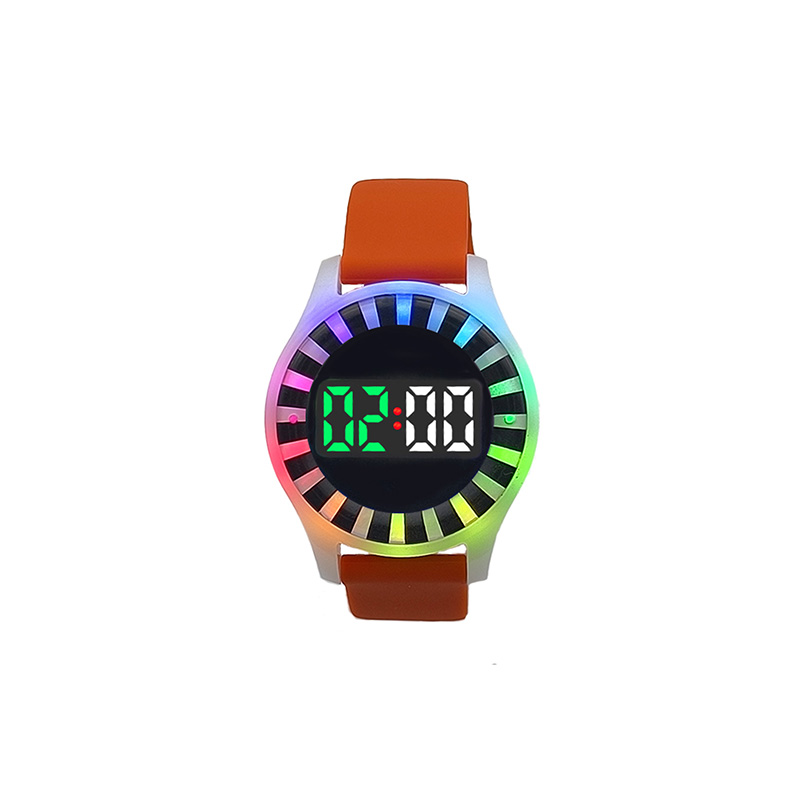
RFID vibration timer wristband with a digital countdown display and multicolor LED indicators.
Why Is Regular Vibration Timer Wristband Maintenance Important?
Reusable vibration timer wristbands are handled repeatedly by different visitors and staff members. In high-volume entertainment venues, a single device may go through many charging, issuing, collecting, cleaning, and resetting cycles.
Regular maintenance helps distributors and their customers address several common operational concerns:
- Battery performance: Identifying charging problems before a wristband becomes unavailable during business hours.
- Countdown accuracy: Checking whether the timer starts, counts down, and records overtime correctly.
- Vibration alerts: Making sure visitors receive the intended reminder when their session is nearly finished.
- LED display condition: Confirming that the remaining time and status indicators are visible.
- RFID identification: Checking that compatible readers can identify the wristband consistently.
- Physical condition: Detecting damaged straps, loose components, worn fastening structures, or signs of moisture ingress.
For wholesalers, maintenance knowledge also improves product support. Instead of treating every customer complaint as a manufacturing defect, distributors can first determine whether the issue is related to charging, operating procedures, device configuration, or physical damage.
Meihe's RFID countdown vibration wristband for attractions and timed rentals is designed for reusable operation in businesses that manage fixed activity sessions and equipment rental periods.
Daily Inspection Checklist for Distributors and Wholesalers
Daily inspection is the first step in maintaining a reliable inventory of vibration timer wristbands. Distributors supplying entertainment venues should recommend a simple inspection routine before devices are issued to customers or transferred to another operating location.
The following checklist covers the main components that should be inspected.
| Inspection Item |
What to Check |
Recommended Action |
| Display screen |
Check visibility, missing segments, and abnormal flickering. |
Test the display and separate defective units. |
| Vibration motor |
Check whether reminder vibrations work. |
Run a countdown alert test. |
| LED indicators |
Check whether the expected colors and signals appear. |
Compare with the configured reminder program. |
| Wristband strap |
Look for cracks, stretching, or damaged buckles. |
Replace damaged straps where possible. |
| Charging contacts |
Check for dirt, corrosion, or physical damage. |
Clean and dry according to manufacturer instructions. |
| RFID function |
Confirm that the reader recognizes the wristband. |
Test with a compatible RFID reader. |
| Device housing |
Inspect cracks, gaps, loose parts, and moisture signs. |
Remove questionable devices from service. |
Distributors managing large inventories should record the inspection results by batch number or device identification number. This makes it easier to identify repeated problems and distinguish isolated failures from issues affecting an entire shipment.
Battery Charging and Power Management
Battery maintenance is one of the most important parts of managing rechargeable vibration timer wristbands. Unlike passive RFID bracelets, electronic countdown wristbands require power to operate the digital display, LED indicators, and vibration motor.
For wholesalers supplying multiple entertainment venues, a standardized charging procedure helps customers reduce unnecessary downtime and improve device availability.
Recommended battery maintenance practices include:
- Use the charging cable, magnetic connector, and power supply specified for the wristband model.
- Check the charging contacts before connecting the device.
- Make sure the magnetic charging connector is correctly aligned.
- Avoid charging devices with wet or visibly damaged charging contacts.
- Disconnect fully charged devices according to the manufacturer's charging instructions.
- Keep charging equipment in a dry, ventilated location.
- Record devices that repeatedly fail to charge or show unusually short operating times.
For reference, the Meihe MH-CR03 uses a 200 mAh polymer lithium-ion battery and magnetic charging. Its published product specifications list a charging time of approximately 120 minutes and standby time of more than 100 hours. Actual operating time depends on the product version, display activity, reminder settings, and usage conditions.
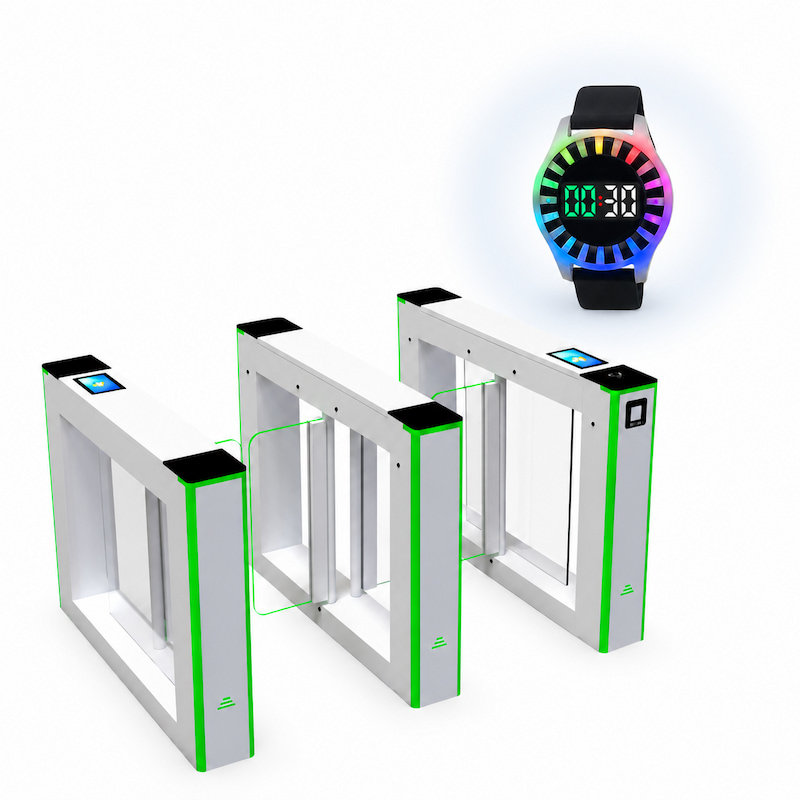
RFID countdown wristband used with access control equipment in timed entertainment venues.
When the number of wristbands increases, manual charging may become difficult to manage. Meihe provides supporting charging options, including multi-position magnetic charging equipment, to help venues organize reusable devices.
Distributors can also review the RFID countdown wristband system and charging solutions when planning larger installations.
How to Clean and Store Vibration Timer Wristbands
Wristbands come into direct contact with users' skin and may be exposed to sweat, dust, cosmetics, and other contaminants. Proper cleaning is necessary for venues that collect and redistribute reusable devices.
However, electronic countdown wristbands should not be cleaned in the same way as ordinary silicone bracelets. The electronic housing, display, buttons, and charging contacts need additional protection.
Cleaning recommendations:
- Use a soft, lint-free cloth to remove surface dust and fingerprints.
- Follow the manufacturer's approved cleaning instructions for the strap and electronic housing.
- Avoid immersing the complete electronic device unless the exact model has a verified waterproof rating and the cleaning method is approved.
- Do not use strong solvents, abrasive cleaners, or unapproved chemical disinfectants.
- Keep liquid away from charging contacts and exposed connection areas.
- Allow the device to dry completely before charging or returning it to inventory.
Storage recommendations:
- Store wristbands in a clean, dry environment.
- Keep devices away from direct sunlight and excessive heat.
- Prevent heavy objects from pressing against the display or housing.
- Separate fully tested devices from damaged or untested inventory.
- Use organized storage trays to prevent straps and charging contacts from being damaged.
One important point for distributors: silicone strap material does not automatically make the entire electronic wristband waterproof. Waterproof performance depends on the complete device construction, seals, buttons, charging structure, and verified product specifications. Always confirm the exact model before recommending immersion or wet-area use.
For projects that require passive waterproof identification rather than an electronic timer, Meihe also offers custom waterproof RFID silicone wristbands as a separate product option.
Countdown Timer and Vibration Function Testing
A wristband may look normal and still have an internal problem. For this reason, distributors should periodically test the complete countdown process rather than checking only whether the display turns on.
For the MH-CR03, the standard operating process uses a dedicated Timer Setter to write the selected countdown duration. The timer begins after the time is successfully written in the standard operating mode.
A practical functional test should include the following steps:
- Check the device: Confirm that the wristband has sufficient battery power and no visible physical damage.
- Connect the time setter: Use the compatible time-setting device according to the operating instructions.
- Write a test duration: Set a short countdown period appropriate for testing.
- Check the display: Confirm that the remaining time appears correctly.
- Test the LED indicators: Verify the expected visual signals under the selected reminder program.
- Test vibration: Confirm that the motor responds at the configured reminder point.
- Check expiration behavior: Verify the selected end-of-session and overtime functions.
- Clear or reset the timer: Prepare the device for the next test or operating cycle.
For the standard MH-CR03 configuration, the countdown can be set in one-minute or 30-minute increments, up to 24 hours. The standard reminder program includes a yellow LED indication and three vibration alerts five minutes before expiration. Expiration and overtime behavior depend on the selected reminder program.
Distributors should keep a record of the tested countdown settings and reminder behavior. This is particularly useful when supplying different customers with different operating requirements.
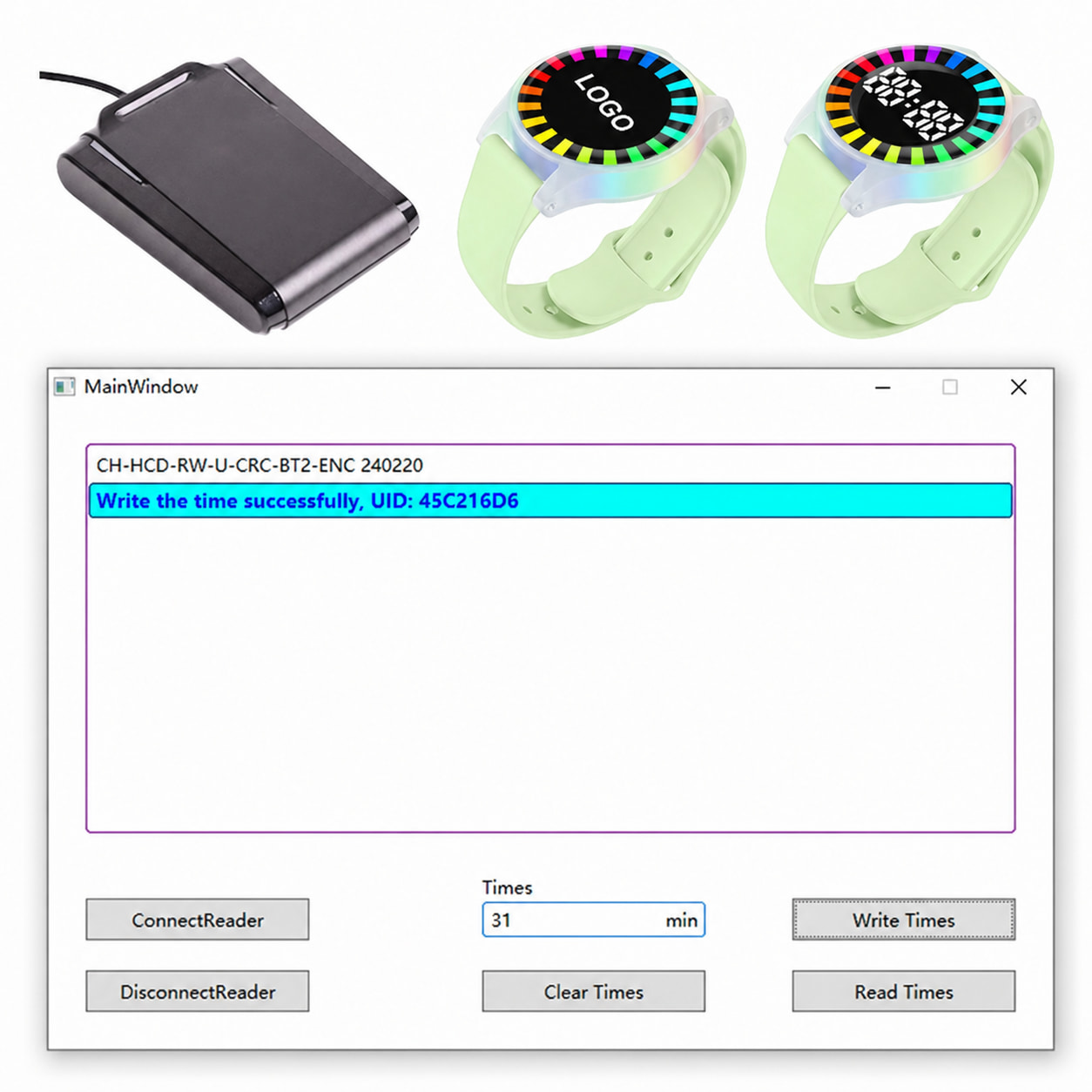
Dedicated time setter and computer interface for programming RFID countdown wristbands.
RFID Reading and System Compatibility Checks
For RFID-enabled vibration timer wristbands, identification performance is another important part of routine maintenance. A wristband may display the countdown correctly but still fail to communicate with an access control reader if its RFID configuration or the reader setup is incorrect.
Distributors should verify the following:
- RFID frequency matches the intended reader.
- Chip type and protocol are supported by the existing system.
- Wristband identification data can be read consistently.
- Reader distance and positioning are suitable for the application.
- Access permissions correspond to the correct wristband records.
- Timer setting and RFID identification functions operate as expected.
The MH-CR03 product configuration uses 13.56 MHz RFID technology with an ISO 14443A-compatible interface and 1K Byte memory. However, RFID compatibility should never be determined by frequency alone. Chip type, data format, authentication, and reader configuration also need to be checked.
For wholesalers supplying complete installations, Meihe can provide wristbands together with compatible time-setting and access management equipment. Review the RFID countdown wristband and turnstile management solution for an example of how these components work together.
Common Vibration Timer Wristband Problems and Troubleshooting
When customers report a malfunction, distributors should first identify which function is affected. This helps narrow down the possible cause and prevents unnecessary replacement of otherwise functional devices.
| Common Problem |
Possible Cause |
Recommended Check |
| Wristband does not turn on |
Low battery, charging issue, or internal fault |
Check charging alignment, power supply, and battery response. |
| Display is blank or unclear |
Insufficient power or display damage |
Recharge and test the display button and screen. |
| No vibration reminder |
Reminder configuration or motor malfunction |
Verify the reminder program and run a controlled test. |
| Countdown does not start |
Time was not written successfully or incorrect operation |
Reconnect the compatible Timer Setter and check the write result. |
| RFID reader cannot identify the device |
Reader incompatibility, data settings, or chip issue |
Verify frequency, protocol, encoding, and reader operation. |
| Battery runs out unusually quickly |
Frequent operation, battery aging, or charging problems |
Compare runtime under consistent test conditions. |
| Charging is intermittent |
Dirty contacts, poor alignment, or damaged charging accessories |
Inspect the connector and test with approved charging equipment. |
If basic checks do not resolve the issue, distributors should record the model, batch information, device identification, operating conditions, and test results before requesting technical support.
Do not open the electronic housing, replace the battery, or modify the charging circuit without manufacturer approval. Unauthorized repairs may create additional faults and affect product safety or warranty coverage.
Inventory Management for Bulk Orders and Wholesale Distribution
Maintaining a few wristbands is relatively simple. Managing hundreds or thousands of rechargeable devices requires a more structured process.
Distributors and wholesalers can improve inventory control by separating devices according to their maintenance status.
A practical inventory classification system may include:
- Ready for use: Fully inspected, charged, and functionally tested devices.
- Charging: Devices currently undergoing normal charging.
- Under inspection: Devices awaiting display, vibration, or RFID testing.
- Needs maintenance: Devices with minor issues requiring approved servicing.
- Out of service: Devices with suspected battery, electronic, or structural defects.
It is also useful to maintain a basic maintenance record for each batch.
| Record Field |
Purpose |
| Product model |
Distinguishes different wristband configurations. |
| Batch number |
Helps trace production and supply records. |
| Device ID |
Identifies individual RFID devices where applicable. |
| Charging status |
Tracks battery and charging availability. |
| Inspection result |
Records display, vibration, LED, and RFID test results. |
| Maintenance history |
Identifies recurring problems and repair records. |
| Current status |
Shows whether a device is ready, charging, or out of service. |
For high-volume customers, multi-position charging equipment can simplify device collection and preparation. Meihe's countdown wristband solutions offer supporting charging accessories, including floor charging racks and multi-port charging units, depending on the selected configuration.
How Often Should Vibration Timer Wristbands Be Maintained?
Maintenance frequency depends on daily usage, operating conditions, the number of visitors, and the manufacturer's instructions. A device used continuously in a busy trampoline park may require more frequent inspection than one used occasionally for equipment rental.
The following schedule is a practical starting point for distributors to recommend to their customers. It is an operational guideline, not a mandatory service interval specified by the manufacturer.
| Frequency |
Maintenance Task |
| Before daily use |
Check battery status, display, strap, and basic operation. |
| After collection |
Clean the wristband according to approved procedures and inspect for damage. |
| Weekly |
Review charging performance, RFID reading, and recurring complaints. |
| Monthly |
Perform a more complete countdown, LED, vibration, and charging inspection. |
| Periodically |
Review battery aging, strap condition, storage practices, and maintenance records. |
Distributors should adjust the schedule according to actual usage and the operating manual supplied with the product. Devices showing abnormal heating, swelling, moisture ingress, or charging behavior should be removed from service immediately.
What Distributors Should Confirm Before Placing a Wholesale Order
Maintenance requirements begin before the products arrive. Choosing the correct model and accessories can reduce after-sales problems and make it easier for distributors to support their customers.
Before placing a bulk order for vibration timer wristbands, confirm the following details with the manufacturer:
- Product configuration: Confirm the model, display type, strap material, and reminder functions.
- RFID specifications: Check frequency, chip type, protocol, and compatibility requirements.
- Battery specifications: Confirm battery capacity, charging method, and expected operating conditions.
- Charging accessories: Determine whether customers need individual cables, multi-port chargers, or floor charging racks.
- Time-setting equipment: Confirm whether an offline Timer Setter or computer-connected solution is more appropriate.
- Customization: Discuss logo printing, strap colors, locking styles, and reminder programs.
- Waterproof requirements: Obtain written confirmation of the exact product version's waterproof rating and test conditions.
- After-sales support: Clarify technical documentation, spare parts, warranty conditions, and troubleshooting procedures.
For distributors supplying complete amusement park projects, ordering only the wristbands may not be sufficient. Timer setters, charging equipment, compatible RFID readers, and access control components should be considered as part of the overall solution.
Meihe provides RFID wristbands and countdown vibration bracelet product categories for different identification and time management applications. Distributors can discuss product configurations and accessory requirements according to their target markets.
Why Work with Meihe for RFID Countdown Vibration Wristbands?
For distributors and wholesalers, a dependable supplier should provide more than a finished wristband. Product consistency, technical specifications, compatible accessories, customization options, and clear communication are also important when building a long-term supply relationship.
Meihe focuses on RFID products and wearable identification solutions, including the MH-CR03 RFID countdown vibration wristband for time-based entertainment applications.
The MH-CR03 product configuration combines several functions:
- 13.56 MHz RFID identification with an ISO 14443A-compatible configuration.
- Digital countdown display with settings up to 24 hours.
- LED status indicators and vibration reminders.
- Rechargeable 200 mAh polymer lithium-ion battery.
- Magnetic charging and reusable wristband construction.
- Multiple silicone strap styles and customization options.
Meihe can also supply supporting time setters and charging equipment for customers developing complete countdown and access management projects.
For wholesalers, this creates opportunities to supply not only individual wristbands but also supporting products required for installation, daily operation, and ongoing maintenance.
If you are planning a wholesale purchase, distributing countdown wristbands to entertainment venues, or developing an RFID time management solution, contact Meihe to discuss product specifications, sample testing, customization, and accessory requirements.
Looking for an RFID vibration timer wristband supplier? Visit the Meihe MH-CR03 countdown vibration wristband product page to review the product configuration and discuss your wholesale requirements.
Frequently Asked Questions About Vibration Timer Wristband Maintenance
How often should vibration timer wristbands be maintained?
Basic inspection should be performed before daily use, while cleaning and physical checks should be carried out after collection. A more complete inspection of charging, RFID, display, and vibration functions can be scheduled weekly or monthly according to usage intensity.
How do you clean an RFID countdown vibration wristband?
Use a soft cloth and manufacturer-approved cleaning products. Avoid immersing the electronic wristband unless its exact model has a verified waterproof rating and the cleaning procedure is approved. Make sure the charging contacts are dry before charging.
How long does the MH-CR03 wristband take to charge?
The published MH-CR03 specification lists an approximate charging time of 120 minutes using magnetic charging. Actual charging performance should be checked against the supplied product version and approved charging equipment.
Why is my vibration timer wristband not vibrating?
Possible causes include low battery power, an incorrect reminder setting, or a vibration motor problem. Recharge the device, confirm the selected reminder program, and run a controlled countdown test. If the problem continues, contact the supplier.
Can RFID countdown vibration wristbands be reused?
Yes. Reusable models such as the MH-CR03 can be collected, cleaned, reset, recharged, inspected, and issued to other visitors. A consistent maintenance and inventory process helps support repeated use.
What is the battery capacity of the MH-CR03?
The published MH-CR03 specification lists a 200 mAh polymer lithium-ion battery. Battery performance depends on charging condition, operating frequency, display activity, and reminder usage.
Can wholesalers purchase charging equipment together with countdown wristbands?
Yes. Meihe offers supporting charging equipment, including multi-position magnetic charging racks and multi-port charging units, depending on the selected configuration and project requirements.
Are all RFID vibration timer wristbands waterproof?
No. Waterproof performance depends on the specific model and construction. Distributors should obtain confirmation of the complete device's waterproof rating and test conditions before recommending use in swimming pools or other wet environments.
How can distributors reduce after-sales problems with vibration timer wristbands?
Distributors can reduce avoidable issues by confirming product specifications before ordering, testing samples, providing charging and cleaning instructions, maintaining batch records, and checking display, vibration, RFID, and battery performance before shipment or customer delivery.





 IPv6 network supported