Leave A Message
If you are interested in our products and want to know more details,please leave a message here,we will reply you as soon as we can.

To choose an outdoor UHF on-metal RFID tag, start with the asset's mounting surface, the distance at which it needs to be read, and the conditions it will face outdoors. A flexible on-metal label is a good starting point for a smooth surface with limited clearance. A rugged, hard-shell tag is a better candidate for equipment exposed to repeated impacts or rough handling. Before ordering in bulk, test the tag on the actual asset with the mounting method and reader you plan to use.
Start with the metal surface and mounting location
An on-metal RFID tag, also called an anti-metal RFID tag, is designed to operate when mounted on metal. A conventional UHF label can lose read performance when placed directly on a metal surface because the metal affects how the tag antenna operates.
Look at the exact spot where the tag will go. A flat panel on a steel cabinet, a curved pipe, and the recessed side of a metal container present different mounting conditions. Check the available footprint, surface curvature, and whether a handle, frame, or adjacent asset could block the reader's view.
For a returnable metal container, for example, a tag on the outer face may be easy to read when the container is on its own. If that face is covered when containers are stacked, test a position that stays exposed in the stack before choosing a tag.
Set the read range based on how the asset moves
Define where the reader will be and what a successful read looks like in daily use. The antenna, tag orientation, and reader configuration all affect the distance at which a tag can be read.
|
Reading workflow |
What to verify |
|
Handheld inspections |
Can staff read the asset from a practical working distance and from the side they normally approach? |
|
Fixed gate or portal |
Is the asset detected as it passes through at normal speed and in its typical orientations? |
|
Stacked containers or grouped equipment |
Which tags are detected in the normal arrangement? Are misses concentrated in particular positions? |
Use the reader model, antenna setup, and regional UHF configuration planned for the site. When comparing datasheets, check the conditions behind each read-range figure. A sample test at your required distance gives you a better basis for choosing between tags.
Match outdoor protection to the actual conditions
An asset parked outdoors year-round faces different conditions from one that moves between a warehouse and a covered loading area. List what the tag will encounter and ask for model-specific specifications. Rugged tag families can offer different enclosure ratings, materials, and mounting options across models.
• Rain, dust, and washdown. Check the enclosure's stated ingress protection and whether it covers the cleaning method used on site.
• Direct sunlight and temperature changes. Check UV resistance and the operating temperature range. For adhesive-backed tags, check the adhesive's application and service temperatures as well.
• Impacts and abrasion. Consider contact with forklifts, racks, tools, and other assets during normal handling.
• Salt spray, oils, or cleaning chemicals. If exposure is expected, ask for resistance data for the tag housing and the mounting materials.
If the tag also carries a printed barcode or serial number, include legibility in your outdoor test. Staff may need that identifier for a manual check.
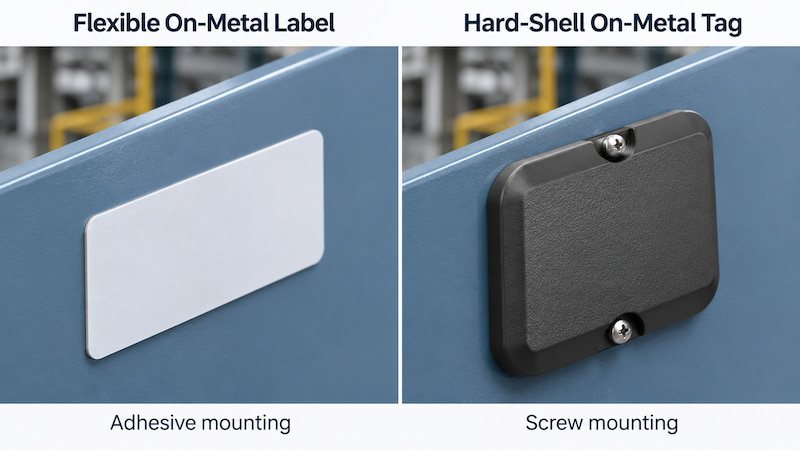
Choose the tag construction and mounting method together
|
Asset or installation condition |
First option to test |
What to check |
|
Smooth metal panel with limited clearance |
Flexible, adhesive-backed on-metal label |
Adhesion to the actual finish and reliable reads from the normal approach angle |
|
Curved metal surface |
Flexible on-metal label rated for the required curvature |
Edge lift and read performance after the label is applied |
|
Outdoor machinery or tools that are handled frequently |
Rugged hard-shell tag |
Impact exposure, mounting clearance, and whether the asset can accept screws or rivets |
|
Painted equipment where drilling is restricted |
Adhesive-mounted on-metal tag specified for the surface |
Bond strength on the actual coating after exposure to the expected weather and cleaning conditions |
|
Stackable metal containers |
On-metal tag mounted on a face that remains exposed in the stack |
Read performance across stack positions and clearance during handling |
For adhesive mounting, follow the supplier's instructions for surface preparation and installation. For mechanical mounting, check the tag’s approved fasteners and whether drilling is permitted on the asset. Industrial hard-shell tags may offer screw, rivet, or adhesive mounting, depending on the model.
Test samples on the asset before placing a bulk order
Test each candidate in the same setup so you can compare results. GS1's Tagged-Item Performance Protocol also takes this approach by evaluating the tagged item under defined conditions, including orientation and frequency.
• Mount the samples on representative assets. Use the intended location, surface finish, and attachment method.
• Run the normal reading workflow. Use the planned reader and antenna setup. Repeat reads at the target distance and angles, or run repeated passes through the portal at normal speed.
• Test the harder cases. Include fully stacked containers, assets facing away from the reader, or tags that are wet after washing if those conditions occur on site.
• Recheck the tag and its mounting after exposure. Look for lifted edges, loose fasteners, damaged housings, or unreadable printed IDs. Repeat the read test.
• Record the results and agree on a pass criterion. Keep the tag model, mounting location, reader settings, number of attempts, and number of successful reads. Use the same setup and acceptance criteria when checking production samples.
For a metal container project, a simple comparison would be to test a flexible label and a hard-shell tag on the same container type, first on a single container and then in a full stack. Record which positions are read consistently and check both tags again after normal handling. That gives the project team a basis for choosing both the tag and its mounting location.
What to send when requesting samples
Send a photo of the asset and proposed mounting location, the surface material and available dimensions, your target read distance, the reader model and deployment country, the outdoor conditions, and your expected order quantity. If assets are stacked or read through a portal, include a photo or a short description of that setup.
Meihe RFID Factory can use these details to recommend on-metal RFID tag samples for testing with your assets and readers.


 IPv6 network supported
Chat NOW
Scan to wechat :

Scan to Whatsapp :

 Product categories